
Making electronic music isn’t just a matter of inspiration: it’s about choosing the right tools, organising an efficient workflow and understanding how each piece of software and hardware boosts creativity. From composition to the final master, the right DAWs and plugins make the difference between a decent track and a hit that hooks the listener.
1. DAWs: the heart of production
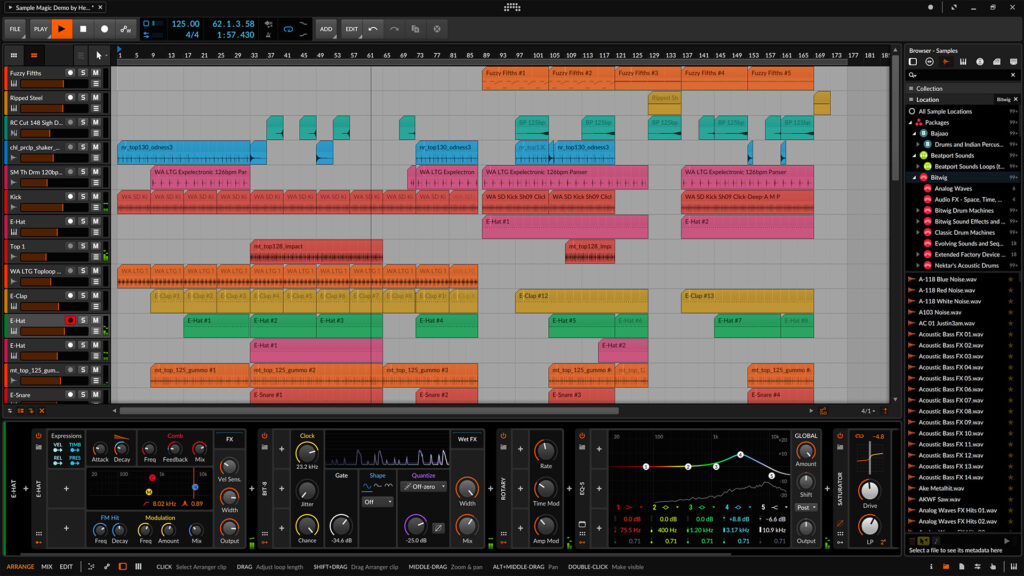
The Digital Audio Workstation (DAW) is the backbone of every producer. It lets you record, arrange, mix and master a complete track. The most widely used in electronic music in 2025 include:
-
Ableton Live:
-
Versatile and agile, ideal for production and live performance.
-
Its clip-based workflow lets you experiment with loops and arrangements quickly.
-
Popular among progressive, melodic house and techno producers.
-
-
FL Studio:
-
Favoured for how easy it makes building beats and rhythmic patterns.
-
Intuitive interface and a large library of native plugins.
-
Excellent for those who produce from scratch and want speed when composing.
-
-
Logic Pro:
-
Mac only, very powerful for synthesis and sampling.
-
Includes high-quality native instruments and professional mixing tools.
-
Its stability and sound quality make it ideal for melodic and cinematic productions.
-
-
Cubase and Studio One:
-
Favoured by producers who prioritise advanced mixing and editing.
-
Excellent for complex tracks with many layers and precise automation.
-
2. Essential plugins: synthesis and effects
A DAW is just a canvas: plugins are the brushes and colours. Some must-haves:
-
Synthesizers: Serum, Diva, Massive X, Omnisphere.
-
They let you create original sounds and unique textures.
-
Used for basslines, leads, pads and ambient effects.
-
-
Mixing effects:
-
Valhalla Reverb, FabFilter Pro-Q3, Soundtoys EchoBoy.
-
To EQ, spatialise and give character to every element of the mix.
-
-
Dynamics processors:
-
Compressors and limiters such as the SSL G-Master Buss Compressor or iZotope Ozone.
-
They make sure every track sounds balanced and powerful, ready for streaming or the club.
-
3. Hardware that still makes a difference
Although most production is digital today, some physical gear is still a benchmark:
-
MIDI controllers: to play synthesizers and create automation in real time.
-
Quality studio monitors: KRK, Yamaha or Adam Audio, essential for mixing accurately.
-
Professional audio interfaces: Focusrite, Universal Audio or RME, for clean, latency-free recordings.
4. A professional workflow
A professional track isn’t born from a flash of inspiration: it’s built by following a workflow:
-
Initial idea: a loop or chord progression.
-
Sound design: synthesis and sampling.
-
Rhythm programming: drums, percussion and groove.
-
Arrangement and structure: intro, drop, breakdown, build-up, outro.
-
Mixing: EQ, compression, reverb and panning.
-
Final master: loudness, coherence and preparation for distribution.
Having a clear workflow saves time, prevents creative blocks and ensures consistent quality.
5. Final tips
-
Try several DAWs and plugins before deciding which one suits your style.
-
Don’t overload your project with too many plugins; simplicity often gives cleaner results.
-
Learn shortcuts and automation: they speed up production and free up creativity.
-
Listen to and analyse reference tracks; understanding how other hits are built gives you perspective for your own productions.
Professional electronic production in 2025 combines creativity, technique and precise tools. Choosing the right DAW and plugins, and keeping a disciplined workflow, is key to turning ideas into quality tracks that connect with the audience. For labels, producers and fans, knowing these tools is both a lesson and a guide towards musical excellence.