

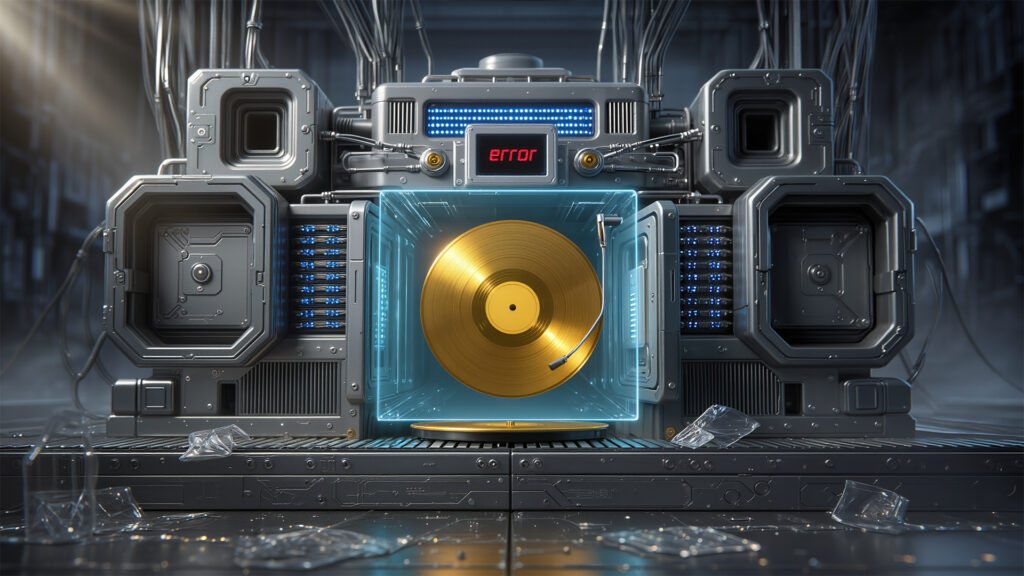

There’s something perverse about today’s industry. You can make a song with an impeccable groove, catchy, upbeat lyrics and an international-level master, and still… Spotify spits you out of the algorithm as if you’d recorded with a laptop mic.
The reason?
Too good.
Yes, you read that right: it sounds too good.
And for a system trained to reward statistical mediocrity, that’s a threat.
The paradox of the perfect sound
Spotify doesn’t measure quality, it measures conformity.
Its algorithm doesn’t ask “does this sound incredible?”, but “does this behave like everything else that’s already playing?”.
If your master has better dynamics, more clarity and a bass that doesn’t fall apart on cheap earbuds, the system flags it as anomalous.
And anomalies don’t get promoted; they get hidden.
So the playlists end up full of:
-
three-word lyrics,
-
recycled beats,
-
vocals so processed they sound like AI, while the artists who produce with judgement, emotion and a clinical ear are punished for sounding too good.
The irony is perfect: mediocrity is the new gold standard.
Institutional discrimination 2.0
On top of that, the human editors (the ones who should balance the game) only review what arrives with “green flags”:
label deals, active campaigns, manufactured growth, fake engagement.
If you come from independence, even if you release 25 records in four months and have real feedback, your pitch doesn’t even get opened.
Meanwhile, the same beat, the same empty line and the same over-compressed mix get in again and again.
The machine is hungry for the familiar, not for the good.
Algorithmic discrimination: the invisible enemy
Spotify doesn’t discriminate against people; it discriminates against deviations.
And quality, innovation and genuine sensitivity are deviations.
They don’t fit its model of “predictable consumption”.
The algorithm doesn’t hate excellence: it simply doesn’t know what to do with it.
That’s why, while average noise gets rewarded, real art is silenced in the name of “engagement”.
Conclusion
The new mainstream isn’t defined by talent, but by statistical compatibility.
And the most tragic part: many of those who dominate the charts today wouldn’t survive 10 seconds without that web of automated bias.
So if you have a song that sounds too good and nobody puts it on the cover…
congratulations. You’re officially guilty of excellence.